
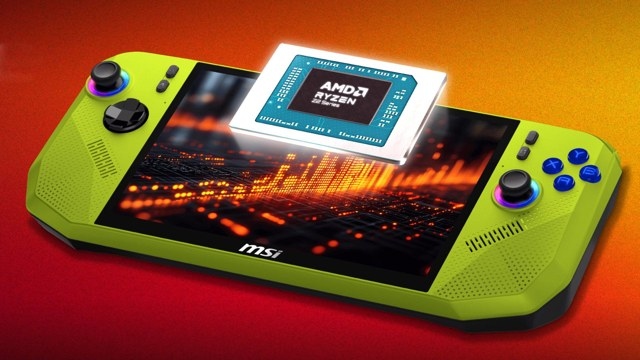
AMD introduced its Ryzen Z2 successors to the Ryzen Z1 and Z1 Extreme at CES in early 2025. The first gaming comparisons suggest that the new handheld APUs offer worthwhile improvements—but their larger graphics hardware cannot always reach its potential.
Tech YouTube channel ETA Prime compared the Ryzen Z2 Extreme-powered MSI Claw A8 with the Asus ROG Ally X, which uses the previous-generation Ryzen Z1 Extreme. The results help explain why simply adding a bigger GPU to a handheld APU is not enough.
How the two handheld chips compare
Here are the specifications of the APUs as configured in these devices:
APU |
Ryzen Z1 Extreme |
Ryzen Z2 Extreme |
|---|---|---|
CPU cores |
8 (Zen 4) |
3 (Zen 5) + 5 (Zen 5c) |
CPU threads |
16 |
16 |
CPU base/boost clocks |
3.3 / 5.1 GHz |
2.0 / 5.0 + 3.3 GHz |
GPU compute units |
12 RDNA 3 |
16 RDNA 3.5 |
GPU boost clock |
2.9 GHz |
2.9 GHz |
RAM |
24 GB LPDDR5x-7500 |
24 GB LPDDR5x-8000 |
The key gaming difference is that the Z2 Extreme has 33% more GPU compute units. Although RDNA 3.5 is not a major leap over RDNA 3, the additional shaders should still produce a noticeable frame-rate increase.
Lower power and resolution widen the lead
In ETA Prime's Cyberpunk 2077 benchmark, however, the Z2 Extreme averaged 47 fps against the Z1 Extreme's 42 fps: a five-frame, or 12%, improvement. Both handhelds used a 25 W power limit, 1080p output, the Steam Deck quality preset, and FSR Balanced upscaling.
Reducing the power limit to 17 W while retaining 1080p produced averages of 39 fps and 32 fps, respectively. That increased the Z2 Extreme's advantage to 22%.
For the final Cyberpunk 2077 test, ETA Prime lowered the resolution to 1600 x 900, cutting the pixel count by 31%. The Z1 Extreme rose only to 35 fps, whereas the Z2 Extreme reached 46 fps—almost matching its 25 W, 1080p result.
Shadow of the Tomb Raider, Forza Horizon 5, Black Myth: Wukong, and Horizon Zero Dawn Remastered followed a similar pattern. At relatively high power limits and resolutions, the two chips performed almost identically. Lowering both settings allowed the newer APU to demonstrate its advantage.
Why more shaders are not enough
These results illustrate the limits of adding shader cores, even when there is enough power to maintain high boost clocks. An APU's CPU and GPU share a memory pool, and the available bandwidth must serve both.
The MSI Claw A8 offers only 7% more memory bandwidth than the ROG Ally X. That is evidently insufficient to feed its 16 RDNA 3.5 compute units at full capacity. Reducing resolution and power eases the shaders' demands on memory, allowing the newer GPU's strengths to emerge.

The limitation is not unique to the Z2 Extreme. The source publication's testing of the OneXFly F1 Pro, shown above, found very little performance difference between its 30 W and 15 W modes, leaving little reason to choose the higher limit. Its Ryzen AI 9 HX 370 also has 16 compute units.
This bandwidth pressure also explains AMD's use of a 256-bit wide memory bus for its Strix Halo APUs. They use the same RAM type and clocks as the Z2 Extreme, but twice the data lanes provide double the bandwidth. Even so, the Ryzen AI Max+ 395 has 40 compute units to supply, raising a similar concern about keeping the GPU fed.
Anyone considering a Z2 Extreme handheld may want to watch ETA Prime's video to understand the practical gains. AMD may be able to improve how its drivers balance power, clocks, and data transfers, but memory bandwidth will remain a limit on achievable performance.

About Nick Evanson
Nick's interest in computers and gaming began in the early 1980s. After university, he taught physics and IT before starting to write about technology in the late 1990s. He wrote 3DMark and PCMark help files with MadOnion, spent a short period at Beyond3D.com, and then joined Futuremark, the renamed MadOnion, as editor-in-chief of its PC gaming site, YouGamers. Following the site's closure, he lectured in engineering and computing for many years before returning to writing, including four years covering technology and PCs at TechSpot.com. GPUs and open-world, grind-heavy RPGs remain particular interests.

