
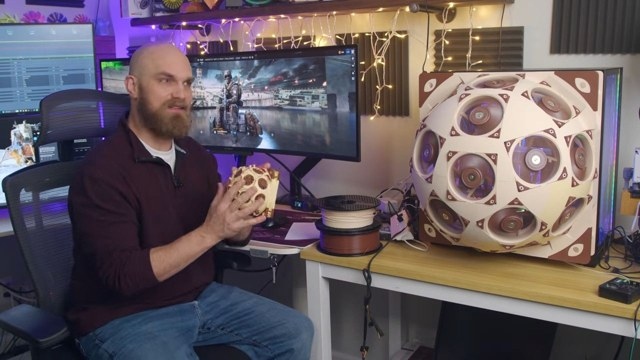
A dome-shaped PC side panel packed with 15 standard 120mm fans has delivered a substantial cooling improvement in YouTuber Major Hardware’s testing. The 3D-printed Superdome reduced his CPU temperature by 20C during gaming, without the excessive noise of the miniature project that inspired it.
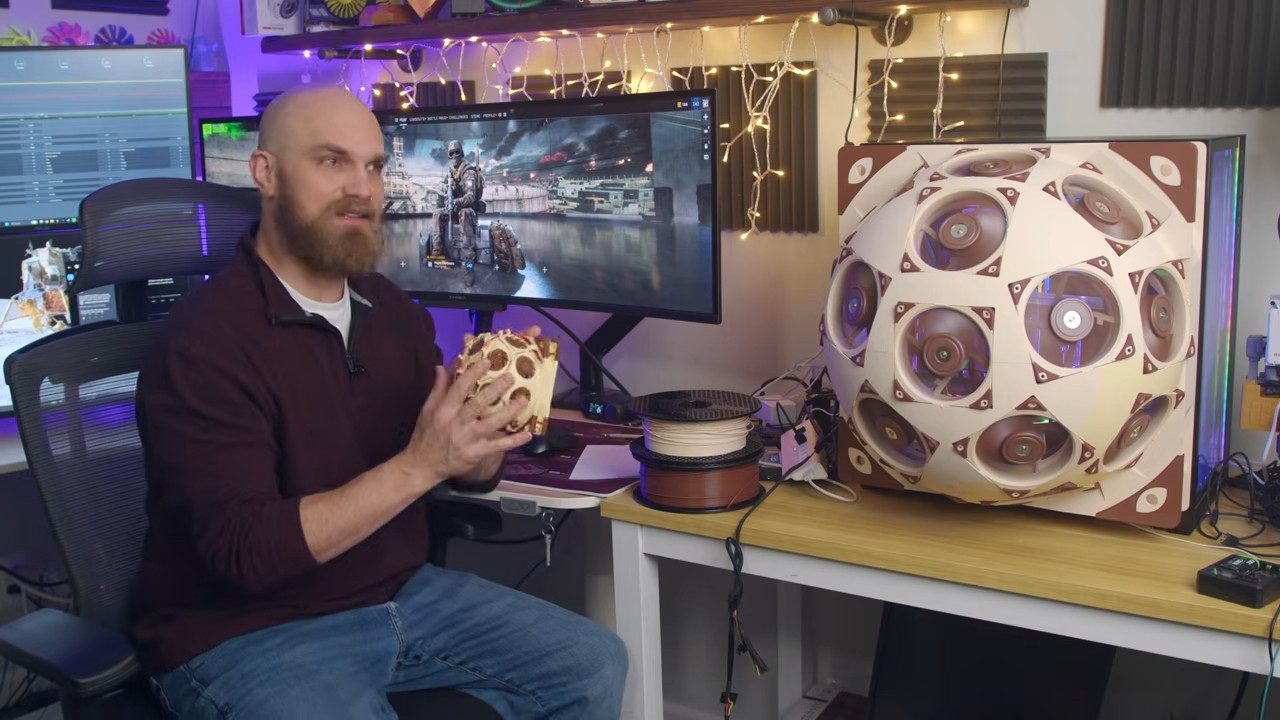
The project, shared on Reddit, grew out of suggestions from viewers of an earlier Major Hardware video.
From miniature joke to full-size side panel
The original build, called ‘The Destroyer of CPUs’, was a playful reinterpretation of the Noctua NF-A12x25. Rather than using one 120mm fan, it arranged 15 tiny 30mm fans into a dome.
Although primarily made for fun, that miniature assembly matched the cooling performance of the full-size Noctua 120mm fan. Major Hardware’s tests actually showed a slight advantage for the custom design, but it was considerably noisier.
Viewers suggested scaling the concept up with full-size Noctua NF-A12x25 fans. Noctua supplied 15 of the 120mm units, and Major Hardware 3D-printed a larger supporting structure. The resulting Superdome fitted onto his Lian Li PC case in place of a side panel.
Lower temperatures without excessive noise
The larger build proved much more practical than its meme-inspired predecessor. During a Battlefield 6 session before the change, Major Hardware recorded a CPU temperature of 86C. He acknowledged that his existing cooling arrangement was not optimal: RGB appearance took some priority over thermal performance because the PC also needed to look good on YouTube.
With the Superdome installed, the Ryzen processor ran at around 66C while playing the shooter—a reduction of 20C. Unlike the small prototype, the larger assembly was not particularly loud; Major Hardware said it “doesn’t make that much noise”.
Power consumption was just under 30W: a noticeable additional demand, but not an enormous one. The design also lacked dust filters. Major Hardware was not especially concerned about that, citing the way his case exhausts hot air, though dust buildup remains something to watch with this kind of panel.
He described the amount of air the Superdome moved as “kind of nuts” and said: “I might just leave it on my PC as is.”
Building one comes at a price
The 3D-printing designs for the Lian Li case are available through the details accompanying the YouTube video, so others can reproduce the build. Buying the fans is a significant expense, however: at the time of writing, each cost $35 in the US. That puts the 15-fan total at $525, before printing and assembly materials.
The result is a distinctive-looking PC with effective cooling in Major Hardware’s testing, but anyone adopting the design should keep an eye on dust accumulation.
Follow TechRadar
Video news, reviews and unboxings are also available on and , with further updates on .

