
By Nick Evanson
Update: Intel has supplied additional information about how XeSS-FG differs between Arc graphics and AMD/Nvidia cards. That clarification is included below.
Intel has launched XeSS 2.1, bringing its frame generation technology to compatible AMD and Nvidia GPUs. The release gives more players another graphics option, particularly GeForce RTX 30-series owners who cannot use DLSS frame generation.
What XeSS 2.1 changes
XeSS is Intel's software kit for developers to integrate upscaling, frame generation and latency reduction into games. Previously, only its upscaler worked on non-Intel graphics hardware. Intel provided two implementations: one using the matrix cores in Alchemist or Battlemage chips, and another using compute shaders.
The two upscalers deliver nearly identical performance gains, although the matrix-core implementation produces slightly better images. With XeSS 2.1, Intel is extending that multi-vendor approach to XeSS-FG, its frame generation component.
XeSS-FG requires Shader Model 6.4 support. Compatible hardware includes AMD Radeon RX 6000, 7000 and 9000 series cards, plus Nvidia GeForce RTX 30, 40 and 50 series cards. That gives it support across more non-Intel GPUs than Intel GPUs.
How frame generation works across GPUs
Intel's approach follows the same broad process as AMD's and Nvidia's: two consecutive rendered frames are held in VRAM instead of immediately being displayed. Processing those frames and the data buffers used to create them allows the system to interpolate an intermediate frame. The resulting sequence delivers a smoother flow of images at a higher displayed frame rate than rendering alone.
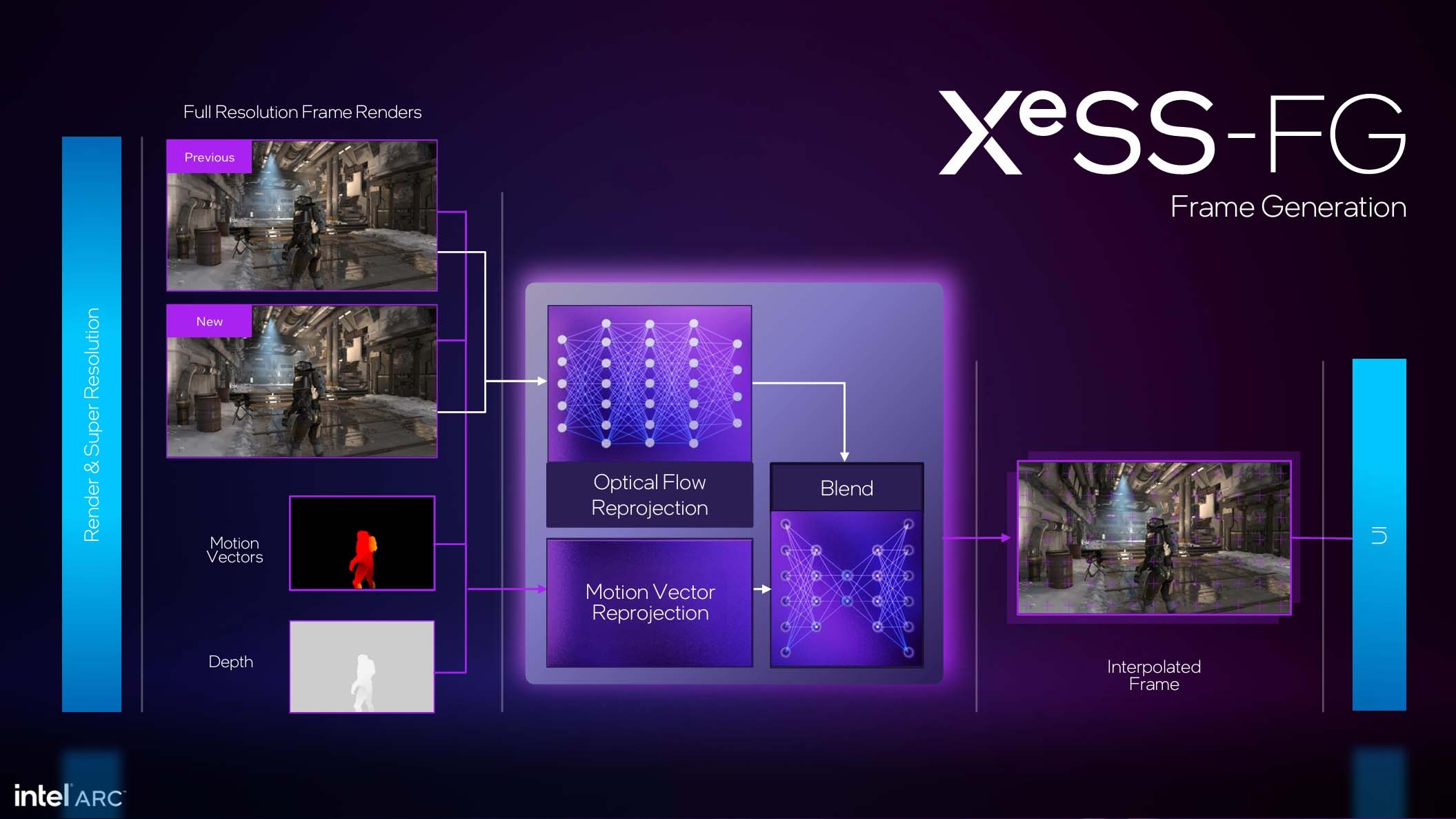
The implementation depends on the hardware. On Intel Arc, a neural network performs interpolation using the GPU's matrix cores. The AMD and Nvidia implementation uses compute shaders, which the initial report likened to FSR frame generation.
Intel's clarification: The company says it developed two AI models to accommodate different levels of AI processing throughput and memory bandwidth. XeSS-FG on AMD/Nvidia hardware is therefore fully AI-based—closer in that respect to DLSS than FSR. Intel expects it to produce better interpolation quality than non-AI alternatives.
Whether the Intel and non-Intel versions differ in performance or image quality remains unknown in this report: a game supporting XeSS 2.1 was not available for comparison.
Games still need updated support
Games that already list XeSS-FG in their graphics menus cannot automatically enable it for AMD or Nvidia cards. Developers must adjust their Intel frame generation integration to support those GPUs. The changes appear relatively modest, raising the prospect of multi-vendor support arriving before too long, though that is not guaranteed.
Availability is another limitation. Intel's game-support page lists just 22 titles with XeSS 2 support. Developers can also add XeSS to games that do not already include it, but whether they choose to invest the effort remains uncertain.
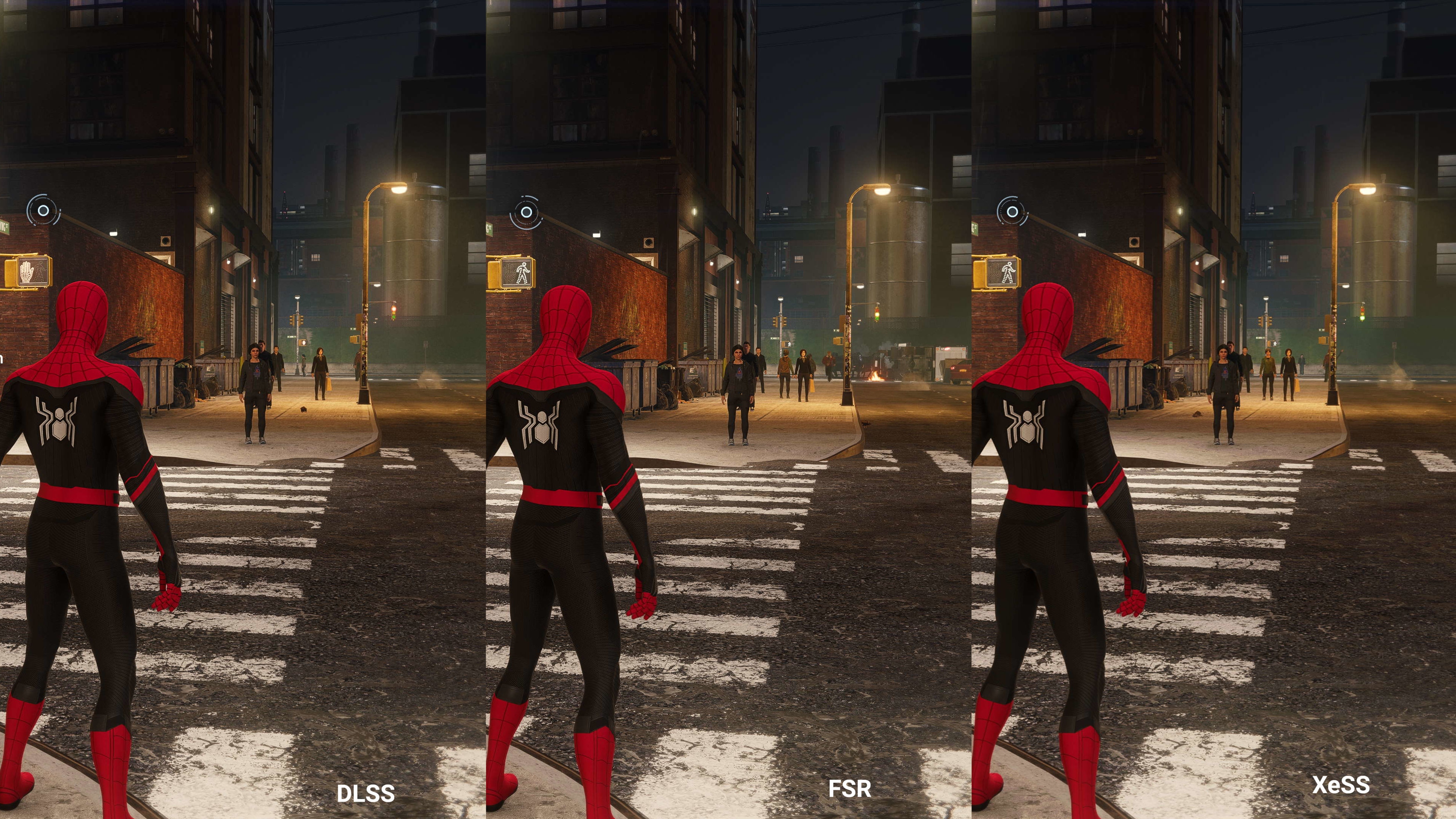
Evanson welcomes the additional choice. Players may generally favour their GPU maker's technology—DLSS for Nvidia, FSR for AMD or XeSS for Intel—but hardware restrictions can make alternatives important. GeForce RTX 30-series cards cannot run DLSS FG; AMD's technology, and now Intel's, give their owners other frame generation options.

About the author
Nick Evanson's interest in gaming and computers began in the early 1980s. After university, he taught physics and IT before beginning his technology-writing career in the late 1990s. He worked with MadOnion on the help files for 3DMark and PCMark, briefly worked at Beyond3D.com, then joined the renamed Futuremark full-time as editor-in-chief of its PC gaming site, YouGamers.
Following that site's closure, he spent years lecturing in engineering and computing before returning to writing, including four years covering technology and PCs at TechSpot.com. His particular interests include GPUs and open-world, grind-heavy RPGs.

