
By Jacob Ridley
AMD has promised neural rendering for Radeon cards and consoles through FSR Diamond. A newly released research paper offers a look at that direction: using image generation to replace global illumination in real time.
Titled “Temporally stable generative illumination with a one-step diffusion model”, the paper describes generating realistic lighting frame by frame. Rather than repeatedly denoising an image, as diffusion models often do, this approach produces its output in a single denoising step. It uses scene details and existing lighting to guide generation, with the single-step design helping limit processing time.
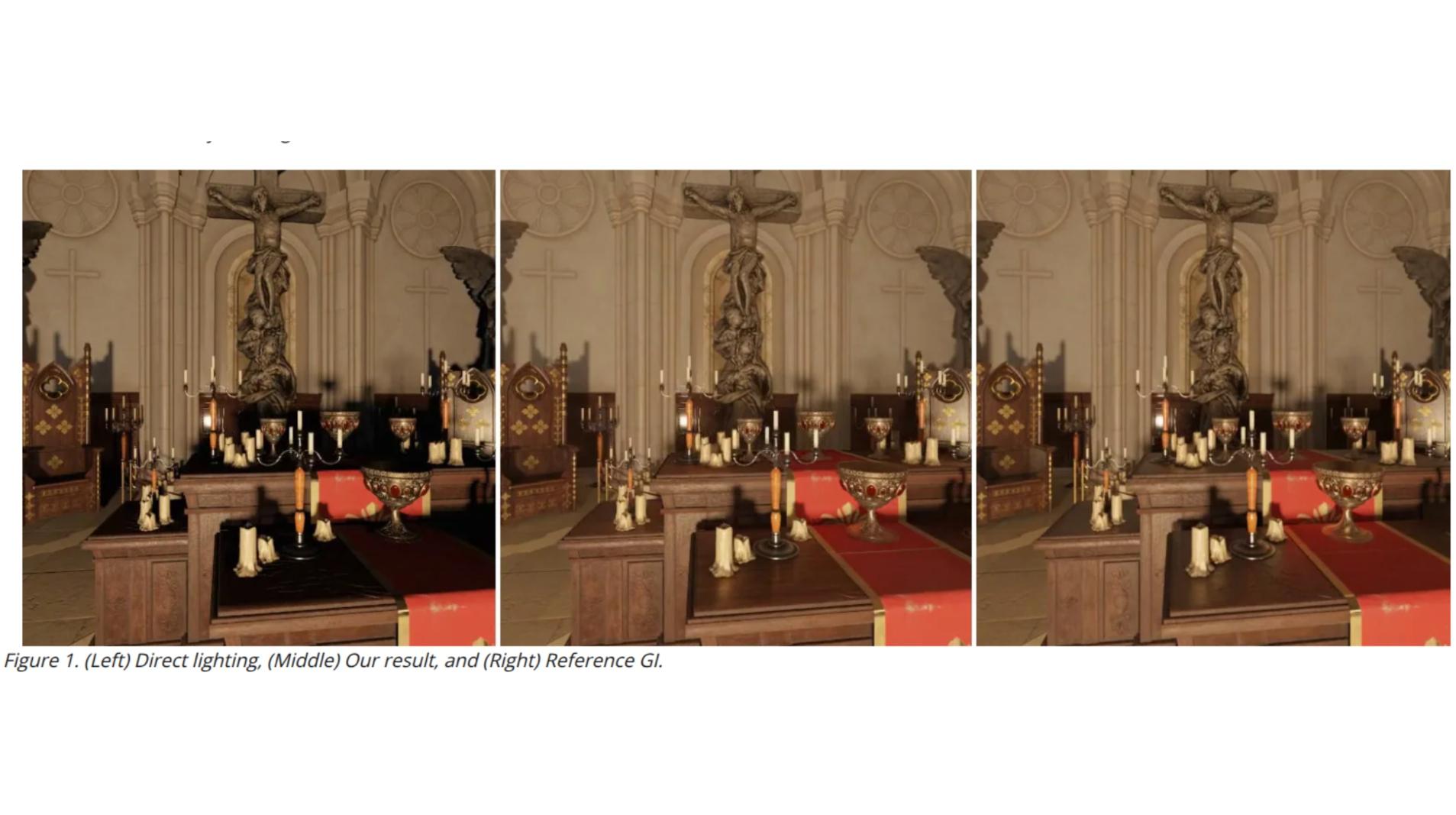
The aim is to reproduce global illumination—light bouncing from objects onto nearby surfaces—without relying on computationally expensive methods such as path tracing.
“In our work, we try to solve global illumination as an image generation problem,” co-author SungYe Kim explains in a video presentation. Kim describes global illumination as both essential to a rendered scene's realism and its most expensive rendering component.
How AMD guides the generated lighting
The system starts with a directly lit frame, where light travels from its source to an object without further bounces. That serves as a lighting hint for Stable Diffusion 2.1 Turbo.
Training uses a synthetic dataset of 31,000 interior-scene frames rendered with Blender Cycles, Blender's ray tracing production renderer. Each scene contains 1-30 lights and moving objects, exposing the model to varied lighting conditions. Training runs through the dataset 50 times on AMD Instinct MI210 GPUs.
Sparse lighting, radiance, material, and geometry signals help keep the generated result consistent with the scene. Processing the input frame also directs the model toward illumination rather than other details. That distinction would matter if the technique reached games, given the potentially hostile public reaction to AI tools that alter their appearance.
To maintain consistency over time, the researchers use a temporal VAE, or TVAE. Motion vectors align the current frame with earlier ones, while a history of previous outputs helps prevent flickering or other lighting instability. Without that continuity, repeated generation can produce small differences that become obvious in a real-time sequence.
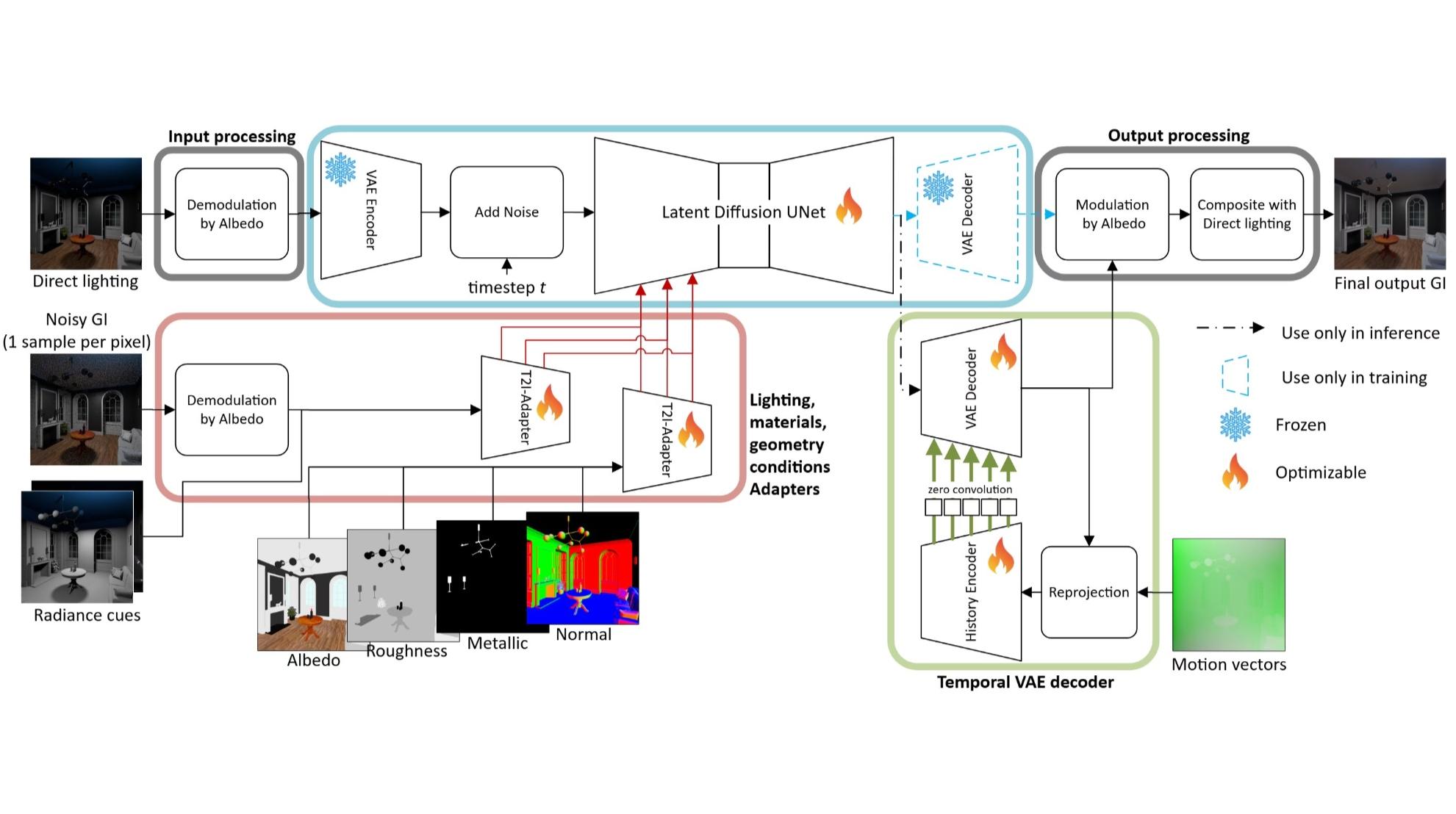
The generated result is composited with the original directly lit frame, which may also soften errors. The accompanying blog describes the method as “suitable for real-time rendering use cases with frame-by-frame generation.”
Kim says it recovers soft shadows and bounced lighting more faithfully than the other generative methods compared: RGB↔X invents content absent from the scene, while DiffusionRenderer distorts geometry.
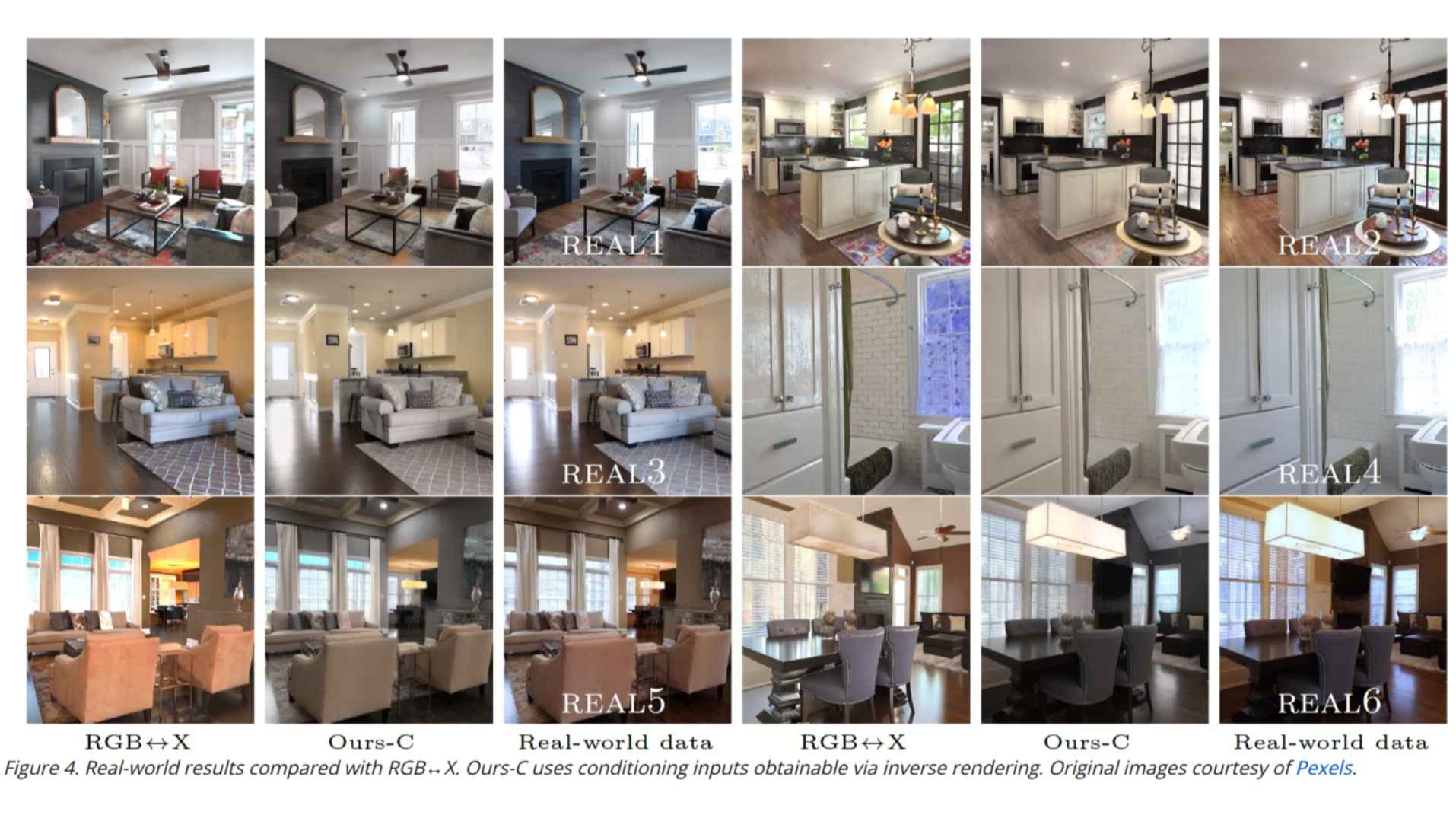
Performance is still far from gaming requirements
The reported processing time is 0.29 seconds per frame—approximately 3.45 frames per second—at 512 x 512 on an RTX 3090. That is considered fast relative to the other named techniques, but still leaves a substantial gap before gaming use. Memory consumption is around 8–9 GB of VRAM, and those requirements cover only global illumination, not the full frame-rendering pipeline.
The research nevertheless reinforces that Nvidia is not alone in pursuing neural rendering. Earlier this year, AMD's Jack Huynh announced FSR Diamond, a suite encompassing “next-gen neural rendering” alongside improved ML-based upscaling, ML-based multi-frame generation, ray regeneration, and path tracing. This paper fits within that neural-rendering category, without establishing a consumer implementation.
In a March 11, 2026 announcement, Huynh also described Project Helix as a multi-year co-engineering partnership with Xbox and @asha_shar, aimed at next-generation performance, graphics, and compatibility with existing Xbox game libraries.
A possible direction, not a confirmed product
How AMD eventually presents these technologies to players will be important. Ridley views the backlash to Nvidia's DLSS 5 announcement—and its subsequent reframing as a developer tool rather than something imposed on gamers—as a warning AMD will likely be watching.
Rumours of AMD neural lighting applications have already appeared, including comments from leaker Kepler_L2 on the Anandtech forums, reported via Overclock3D. It is unclear whether those rumours concern this research or a more advanced implementation. What is clear is that Nvidia is not the only company investigating neural rendering.

Jacob Ridley has covered PC hardware and technology for over eight years, beginning at PCGamesN before joining PC Gamer. His work and interests include building PCs, benchmarking, and learning Linux.

