
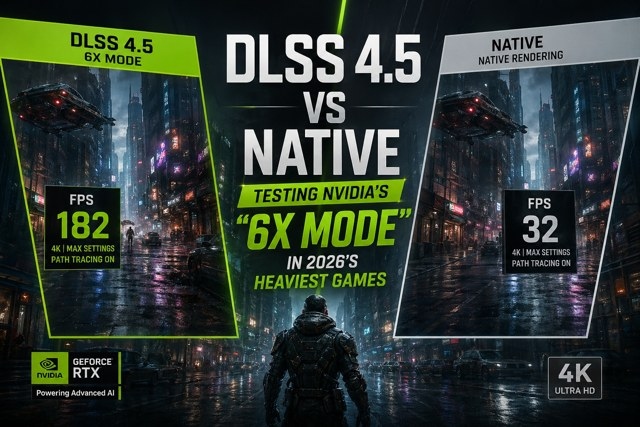
In 2026, PC graphics discussions increasingly center on AI-generated frames rather than native rendering alone. NVIDIA DLSS 4.5 combines upscaling with frame generation, and its 6X Multi Frame Generation mode creates five AI frames for every natively rendered frame. That can transform apparent performance, but it does not make native rendering irrelevant.
How DLSS 4.5 changes frame generation
DLSS 4.5 introduces a second-generation transformer-based AI model and raises the frame-generation multiplier. DLSS 3 could reach 2X and DLSS 4 reached 4X; DLSS 4.5's 6X mode supplies five generated frames alongside each traditionally rendered one.
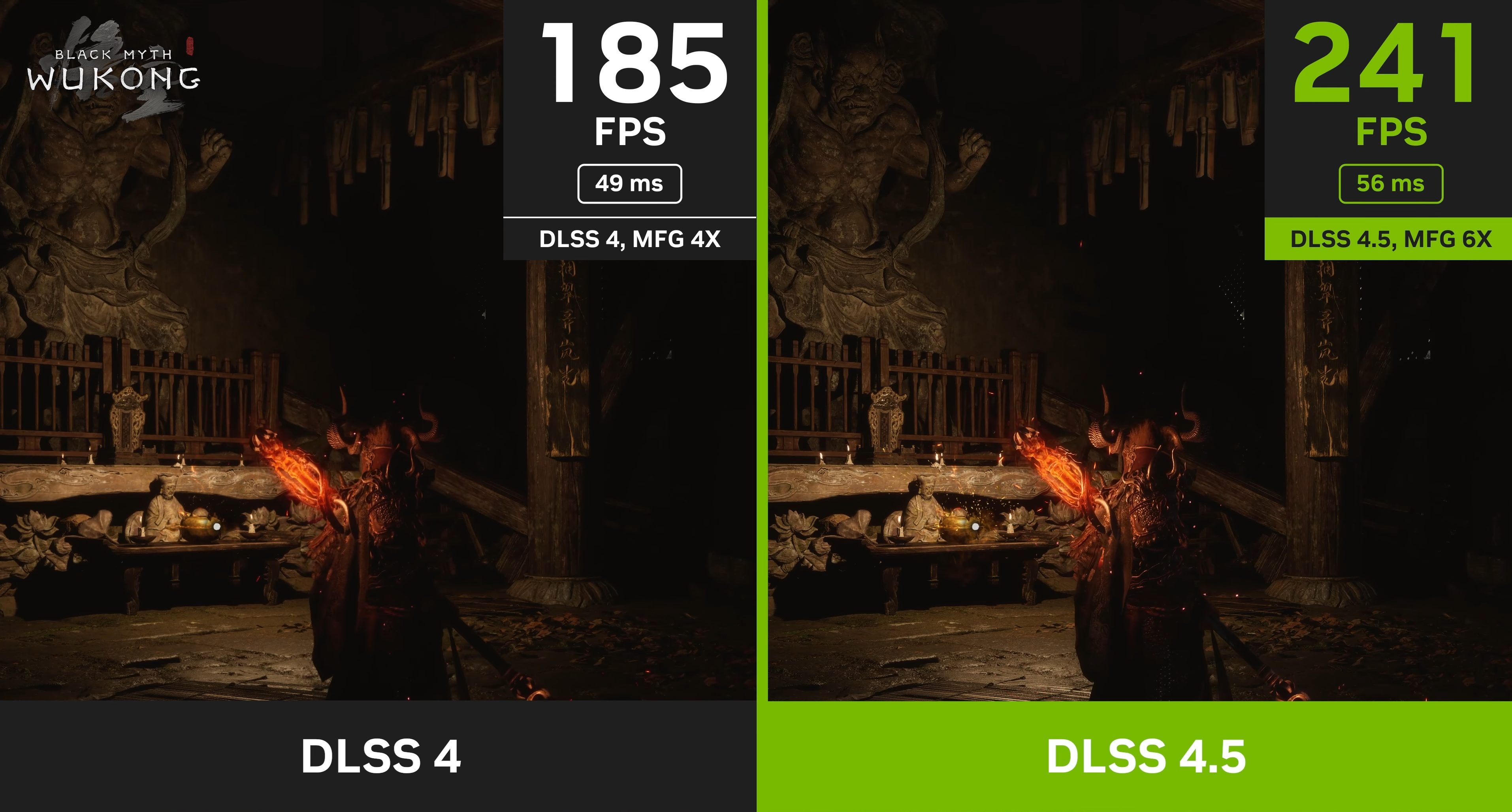
The GPU's rendered frames increasingly serve as references for AI reconstruction rather than accounting for most displayed frames. NVIDIA claims that moving from 4X to 6X increases frame rates by 35% in path-traced 4K scenarios.
Dynamic Multi Frame Generation adjusts the multiplier to suit the performance target and display refresh rate. It shifts between lower and higher frame-generation levels as workloads change, automating the choice needed to reach the desired frame rate.
Why native rendering still matters
Native rendering remains the reference for visual accuracy because the game engine computes every pixel directly, without AI inference. That distinction matters most during fast camera movement, particle-heavy scenes and complicated motion.
The improved transformer model aims to reduce ghosting, shimmering and temporal instability relative to earlier NVIDIA versions. Reconstructed images can match or even appear better than native rendering, particularly in performance mode and when in-game denoising is disabled.
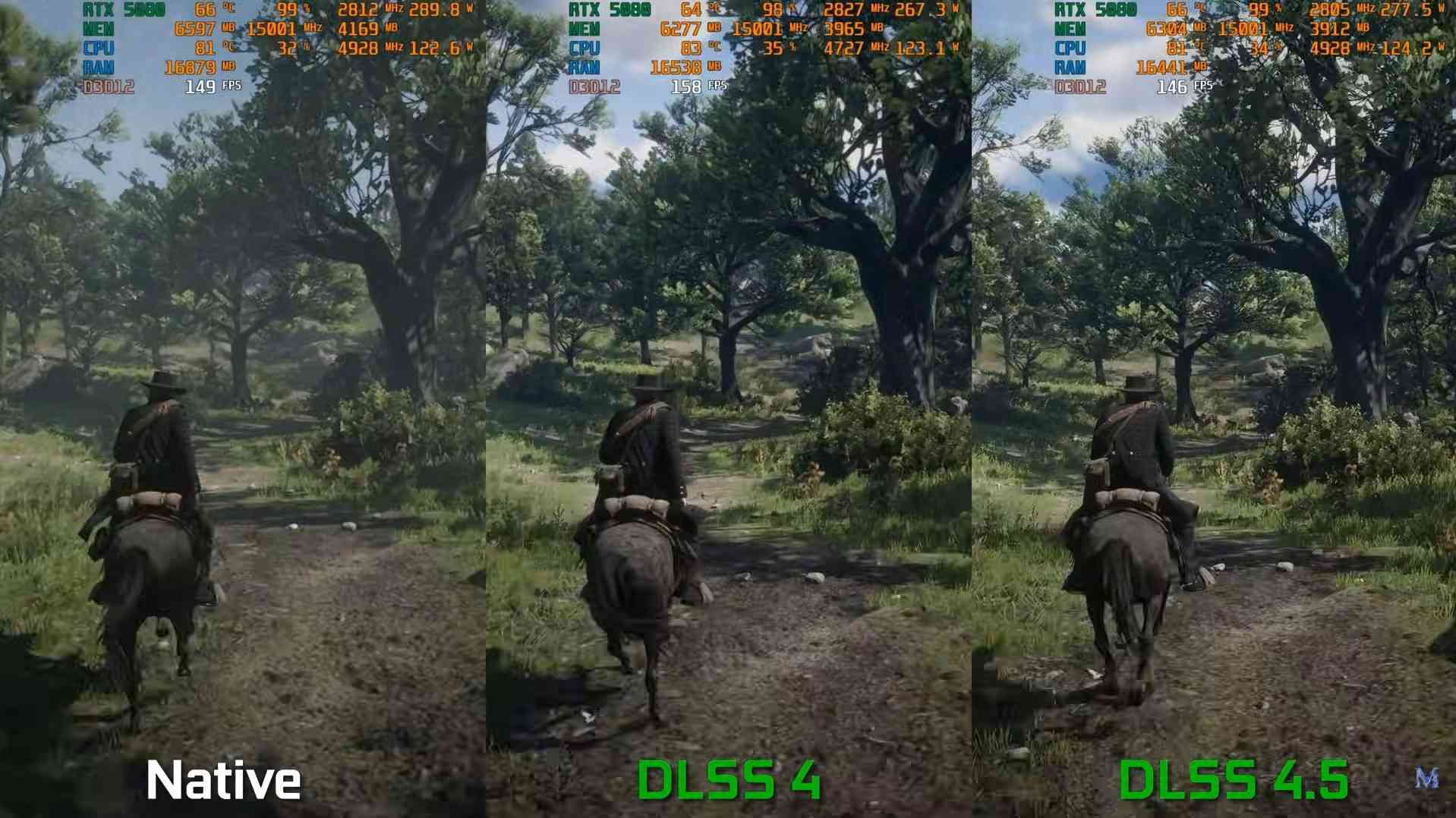
That advantage is perceptual rather than absolute. DLSS 4.5 can look excellent in stationary or slowly moving scenes, yet struggle during fast action. Generated images remain predictions, and those predictions can be wrong.
Performance in demanding 2026 games
Path tracing and dense simulation—including those in upcoming AAA games—provide the toughest conditions for 6X mode. The article describes DLSS 4.5 making ultra settings with full path tracing playable, with games running at 30 to 40 FPS natively exceeding 120 FPS through aggressive frame generation.
There is an important limit: when the native frame rate becomes too low, the system lacks sufficient information to generate consistent intermediate frames. Visual irregularities and lag can follow. AI improves the experience, but cannot replace a strong underlying rendering baseline.
Higher frame rates do not guarantee faster responses
Additional generated frames do not necessarily make input response faster. NVIDIA's Reflex integration helps control latency as displayed frame rates rise, but the value of that trade-off depends on the game.

For single-player open-world games, greater smoothness and visual quality can outweigh a modest latency penalty. Competitive games place more importance on immediate reactions, making native rendering or lower frame-generation levels preferable. This is the core of the “fake frame” argument: 6X can produce convincing motion without every frame providing equivalent input feedback.
Where 6X fits
DLSS 4.5 points toward a future in which AI-assisted rendering becomes commonplace, delivering displayed frame rates that brute-force rendering cannot match. It is especially appealing to players seeking rich visuals and high refresh rates, but its consistency still depends on a solid native foundation.
Native rendering retains the advantage for competitive play and complex, fast-moving scenes. Neither approach replaces the other: 6X prioritizes apparent smoothness, while native rendering preserves direct image computation and responsiveness.
About the author
Comparisons expert Shehryar Khan is an experienced PC hardware specialist with more than five years in the field. His interests include PC building and new components, and his current build uses a custom loop.
Contact: [email protected]

